

This SMS marketing guide explains how to boost engagement and ROI using targeted messaging, personalization, automation, and analytics, helping businesses reach customers instantly and drive higher conversions effectively.
In today’s digital landscape, SMS marketing has cemented itself as a powerful channel for businesses seeking immediate, personalized engagement with their customers. This year (2026), as competition for attention grows across social media and email platforms, marketers are turning to text message campaigns to cut through the noise. With open rates surpassing 90%, SMS marketing ensures that your time-sensitive offers, appointment reminders, and loyalty updates land directly in the palm of your audience, often resulting in rapid click-throughs and conversions. However, success in SMS marketing requires more than simply blasting messages; it demands strategic list building, segmentation, compliance with regulations, and carefully crafted copy that motivates recipients to act.
In this comprehensive guide, you will learn how to: build and grow an opt-in subscriber list; adhere to legal requirements such as the TCPA and GDPR; segment your audience for maximum relevance; design high-impact messages; schedule sends at optimal times; choose the right platform; and measure key performance metrics. Along the way, authoritative insights from the Pew Research Center and regulatory guidelines from the FCC will provide the data-driven foundation you need. By the end of this article, you’ll have a clear roadmap to launch or refine SMS marketing campaigns that drive ROI, foster loyalty, and deliver unparalleled engagement in 2026.
What Is SMS Marketing and Why It Matters Today
SMS marketing refers to the practice of sending promotional or transactional content via text message to subscribers who have explicitly opted in to receive communications from a brand. Unlike channels that rely on internet connectivity or social algorithms, standard text messages reach customers directly on their mobile devices, ensuring immediate visibility. In today’s fast-paced environment, consumers expect timely information, whether it’s an exclusive discount code or a last-minute event reminder. SMS marketing satisfies that demand by delivering concise, actionable messages almost instantaneously.
Core Features of SMS Marketing
First, SMS messages boast exceptionally high open rates. Studies show that over 90% of texts are opened within minutes of receipt, compared to email open rates that often linger around 20–25%. This immediate reach makes SMS ideal for flash sales, appointment reminders, and time-sensitive notifications. Second, the character limit—typically 160 characters per segment—forces brands to distill their value proposition into a clear, compelling call-to-action. Third, modern SMS platforms offer automation and integration capabilities, enabling triggered messages based on user behavior (e.g., cart abandonment or loyalty milestones).
The Role of Opt-In in SMS Marketing
Because text messaging is inherently personal, regulatory frameworks such as the Telephone Consumer Protection Act (TCPA) in the U.S. and the General Data Protection Regulation (GDPR) in the EU mandate explicit, verifiable consent from recipients. This emphasis on permission-based marketing not only guards against legal risk but also fosters trust, resulting in higher engagement and lower opt-out rates. Today, savvy marketers focus on transparent opt-in processes—such as web form checkboxes or keyword-based subscriptions—to ensure compliance and nurture positive consumer relationships.
Why SMS Marketing Matters for Modern Brands
In today’s omnichannel strategies, SMS marketing fills a critical gap between high-frequency social ads and longer-form email campaigns. It offers real-time communication without the risk of messages being buried in crowded inboxes. Moreover, SMS marketing can amplify other tactics—by sending links to blog posts, videos, or surveys, brands can drive traffic back to owned channels, further enhancing brand affinity. Whether you’re a small retailer or a large enterprise, investing in SMS marketing can yield significant returns on minimal investment, making it a must-have tactic in your 2026 marketing toolkit.
Key Benefits and Strategic Advantages of SMS Marketing

As businesses evaluate their 2026 marketing budgets, SMS marketing often emerges as a cost-effective channel that delivers outsized returns. Here are the primary benefits driving widespread adoption:
1. Exceptional Engagement Rates
SMS messages consistently outperform other digital channels in open and response rates. According to Pew Research Center findings, recipients open over 90% of text messages within three minutes. In contrast, email campaigns can take hours to gain traction, and social media posts may never reach a brand’s full audience due to algorithmic filters.
2. Real-Time Reach
Whether announcing a flash sale, confirming an appointment, or sending an event reminder, SMS ensures that your message arrives instantly. This immediacy is especially valuable for time-sensitive promotions—phrases such as “Today Only” or “Ends at Midnight” leverage a sense of urgency that drives rapid action.
3. High ROI and Low Cost
Compared to paid social ads or direct mail, SMS marketing campaigns typically require minimal spend per message while delivering strong conversion rates. When you factor in the high open rate and immediacy, SMS often yields one of the highest revenue-per-dollar metrics in a marketer’s portfolio.
4. Personalization and Segmentation
Advanced SMS platforms allow you to segment audiences by demographics, purchase behavior, geography, and engagement level. Coupled with dynamic message templates, you can personalize each text with a customer’s name, past purchase details, or tailored recommendations—driving up to 4x higher response rates compared to generic blasts.
5. Automation and Integration
Modern SMS tools integrate seamlessly with CRM, e-commerce, and marketing automation systems. This connectivity enables triggered workflows—such as welcome series, cart abandonment reminders, or loyalty milestone messages—ensuring every customer receives relevant content at the right moment without manual intervention.
Ensuring Compliance: Opt-In Processes and Regulatory Best Practices
Regulatory compliance is at the heart of any sustainable SMS marketing program. Violating rules can result in substantial fines and reputational harm. Here’s how to stay compliant in 2026:
TCPA, GDPR, and Global Privacy Standards
In the United States, the Telephone Consumer Protection Act (TCPA) mandates express written consent before sending promotional texts. Similarly, the General Data Protection Regulation (GDPR) in the European Union imposes strict guidelines on personal data processing and requires clear opt-in. Other jurisdictions maintain local regulations that often follow this permission-based model. Always verify regional requirements before expanding.
Building a Clear Opt-In Flow
• Use web forms with unchecked checkboxes labeled clearly (e.g., “I agree to receive SMS updates”).
• Implement keyword-based opt-ins: have users text “JOIN” to a short code.
• Collect minimal required data—phone number plus timestamp and IP address for record-keeping.
• Confirm opt-ins with a welcome message that includes opt-out instructions (e.g., “Reply STOP to unsubscribe”).
Maintaining Consent Records
Properly archive consent logs, timestamps, and audit trails in case of disputes. Automated platforms typically offer built-in compliance dashboards that track opt-ins, opt-outs, and message history. Regularly purge unsubscribed or invalid numbers to maintain a healthy database and lower costs.
Prohibited Content and Age Restrictions
Avoid sending messages with unlawful offers, gambling, or content to minors if your product is age-restricted. Include disclaimers where necessary, and implement age-gating mechanisms during opt-in to prevent inadvertent violations.
Building and Growing a High-Value Subscriber List
A robust subscriber list is the foundation of a successful SMS marketing program. Today’s savvy marketers employ multiple channels to capture opt-ins and deliver irresistible value in exchange for a customer’s phone number.
Website Pop-Ups and Embedded Forms
Use exit-intent pop-ups or timed overlays that invite visitors to join your SMS list for exclusive discounts or early access. Position forms prominently on high-traffic pages such as your homepage or blog. Keep the submission process simple—request only the phone number and consent checkbox.
Point-of-Sale and In-Store Signups
For brick-and-mortar retailers, train staff to invite customers to text a keyword (e.g., “Text SAVE10 to 12345”) at checkout. In exchange, offer an immediate discount or loyalty points that apply to that visit, driving both opt-ins and same-day revenue.
Social Media and Cross-Promotion
Promote your SMS program on Facebook, Instagram, or Twitter by running limited-time contests that require a text-based entry. Cross-promote via email newsletters, encouraging subscribers to join SMS for flash deals not available elsewhere.
Referral Programs
Leverage existing subscribers by creating referral incentives—offer both the referrer and the new subscriber a reward (e.g., 20% off their next purchase). This approach not only grows your list organically but also increases brand advocacy.
Delivering Continuous Value
Regardless of your acquisition channel, always communicate the specific benefits of joining your SMS list. Whether it’s insider deals, event invitations, or curated content, explicit value propositions drive higher opt-in rates and long-term retention.
Crafting and Optimizing High-Impact SMS Campaigns (Expanded Guide) 
Once you’ve built a compliant subscriber list, the real success of SMS marketing depends on how effectively you craft and optimize your messages. In a space where attention spans are short and competition is high, every word matters. High-performing SMS campaigns are built on clarity, personalization, timing, and continuous optimization. By combining these elements, businesses can turn simple text messages into powerful conversion drivers.
SMS Campaign Optimization Framework
| Element | Best Practice | Tools/Techniques | Expected Result |
|---|---|---|---|
| Message Length | Keep under 160 characters | SMS editors, character counters | Lower cost, higher readability |
| Personalization | Use names, behavior, preferences | CRM, dynamic fields | Higher engagement |
| CTA Optimization | Clear, action-driven phrases | A/B testing | Increased conversions |
| Timing | Send at peak engagement hours | AI timing tools, analytics | Better open & response rates |
| Segmentation | Target based on user behavior | Audience filters, tagging | Relevant messaging |
| Testing | A/B test variations | Campaign experiments | Continuous improvement |
Writing High-Converting SMS Messages
Effective SMS copy must be short, direct, and compelling. Since users read messages within seconds, your value proposition should be instantly clear.
Core Components of a High-Impact SMS
- Attention Hook: Capture interest immediately
- Value Proposition: Highlight benefit or offer
- Call-to-Action (CTA): Tell users what to do next
- Urgency: Encourage immediate action
Example Structure
25% OFF Today Only! Use code SAVE25. Shop now: [link]”
This format ensures clarity while driving quick responses.
Key Optimization Techniques
1. Personalization That Drives Results
Personalized messages create a one-to-one experience, even in mass campaigns.
Examples:
- “Hi John, your favorite items are back in stock!”
- “Sara, enjoy 15% off your next order today!”
Personalized SMS campaigns can increase engagement significantly compared to generic messages.
2. Segmentation for Relevance
Sending the same message to everyone reduces effectiveness. Instead, segment your audience:
- New subscribers → Welcome offers
- Loyal customers → Exclusive deals
- Inactive users → Re-engagement campaigns
Result: Higher CTR and lower opt-out rates.
3. Strong Call-to-Action (CTA)
Your CTA should be clear, simple, and action-oriented:
Effective CTA examples:
- Shop Now
- Claim Your Offer
- Book Today
- Get Started
Avoid vague phrases—clarity increases conversions.
Optimizing Send Time & Frequency
Timing plays a critical role in SMS marketing success.
Best Time Windows
- Morning: 10 AM – 12 PM
- Afternoon: 2 PM – 5 PM
Avoid
- Late night or early morning messages
- Over-messaging (can lead to opt-outs)
Frequency Tips
- Promotions: 2–3 times per week
- Alerts/updates: As needed
Smart timing improves engagement without annoying users.
A/B Testing for Continuous Improvement
Testing helps identify what works best for your audience.
What to Test
- Message wording
- CTA placement
- Offer type (discount vs free shipping)
- Send time
Example Test
- Version A: “20% OFF Today Only”
- Version B: “Save 20% – Limited Time”
Use results to refine future campaigns and boost ROI.
Performance Metrics to Track
| Metric | Purpose | Goal Benchmark |
|---|---|---|
| Open Rate | Message visibility | 90%+ |
| Click Rate | Engagement with links | 10–30% |
| Conversion Rate | Completed actions | 5–20% |
| Opt-Out Rate | User dissatisfaction | <2% |
| ROI | Revenue vs cost | Positive return |
Message Structure and Length
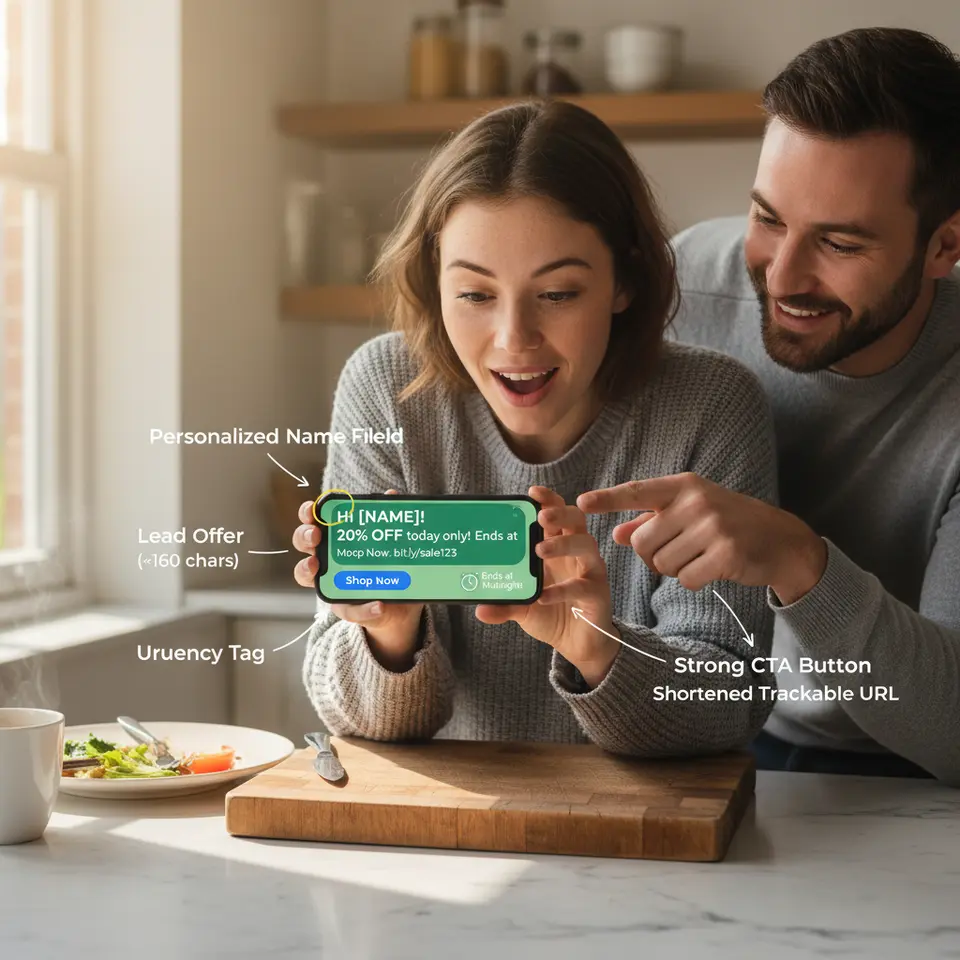
• Keep messages under 160 characters to avoid multiple segments and higher costs.
• Lead with the offer or key benefit (“20% OFF today only”).
• Use strong action verbs: “Shop Now,” “Claim Your Offer,” or “Reply YES.”
• Include a shortened, trackable URL to measure click-throughs.
Personalization and Dynamic Content
Incorporate customer data fields—like first name or recent purchase—to create a sense of one-to-one communication. Segmented campaigns (e.g., new vs. returning customers) enable you to tailor imagery and messaging, generating up to 4x higher engagement compared to untargeted blasts.
Sense of Urgency and Exclusivity
Time-bound offers (“Ends at Midnight”) and limited-quantity alerts (“Only 50 units left”) prompt faster responses. VIP subscriber segments can receive “early access” codes, reinforcing loyalty and driving higher spend per customer.
Optimal Send Times
Test send times in your audience’s local time zones. As a general rule, late morning to early afternoon on weekdays performs well, while evenings and early mornings can lead to higher opt-out rates. For event reminders, schedule messages 24 hours and again one hour before the start time to minimize no-shows.
Testing, Analytics, and Continuous Improvement
A/B test subject lines (first words), CTAs, send times, and message length to identify the highest-performing combinations. Track key metrics—delivery rate, click-through rate (CTR), conversion rate, opt-out rate, and overall ROI ((revenue – cost)/cost). Use these insights to refine your strategy and budget allocation.
In today’s competitive environment, SMS marketing offers an unparalleled opportunity to engage customers quickly, personally, and cost-effectively. By prioritizing clear opt-in processes, adhering to global compliance standards, and continuously optimizing message content, timing, and segmentation, businesses can harness the full potential of text messaging campaigns. From building a high-value subscriber list through in-store prompts and digital promotions to crafting concise, action-oriented copy and analyzing performance metrics, each component plays a critical role in driving sustainable results. Implement these strategies in 2026 to increase open rates, boost conversions, and foster lasting customer loyalty through the immediacy and intimacy of SMS marketing.
FAQs – SMS Marketing
1. What is SMS marketing?
SMS marketing is a strategy where businesses send promotional or transactional text messages to customers who have opted in to receive updates and offers.
2. Why is SMS marketing important in 2026?
It delivers instant communication, high open rates, and strong engagement, making it one of the most effective channels for reaching customers quickly.
3. What is the average open rate of SMS marketing?
SMS messages typically achieve open rates above 90%, significantly higher than email and other digital marketing channels.
4. Is SMS marketing cost-effective?
Yes, SMS marketing offers a high return on investment due to low costs per message and high conversion rates.
5. What are the key benefits of SMS marketing?
Key benefits include instant delivery, high engagement, personalization, automation, and strong ROI.
6. What is opt-in in SMS marketing?
Opt-in means customers give permission to receive SMS messages, ensuring compliance with regulations and building trust.
7. How can businesses grow their SMS subscriber list?
Businesses can use website forms, social media promotions, in-store signups, and referral programs to increase subscribers.
8. What are the best practices for SMS marketing campaigns?
Use clear messaging, strong CTAs, personalization, proper timing, and regular A/B testing to improve campaign performance.
9. What regulations affect SMS marketing?
Laws like TCPA and GDPR require user consent, clear identification, and easy opt-out options in every message.
10. How do you measure SMS marketing success?
Success is measured using metrics like delivery rate, click-through rate (CTR), conversion rate, opt-out rate, and overall ROI.
